

Backscattering Spectrometer

BASIS |  BL-2 | SNS

Mission Statement

Toward advances in life sciences and better materials for energy storage

Instrument Description

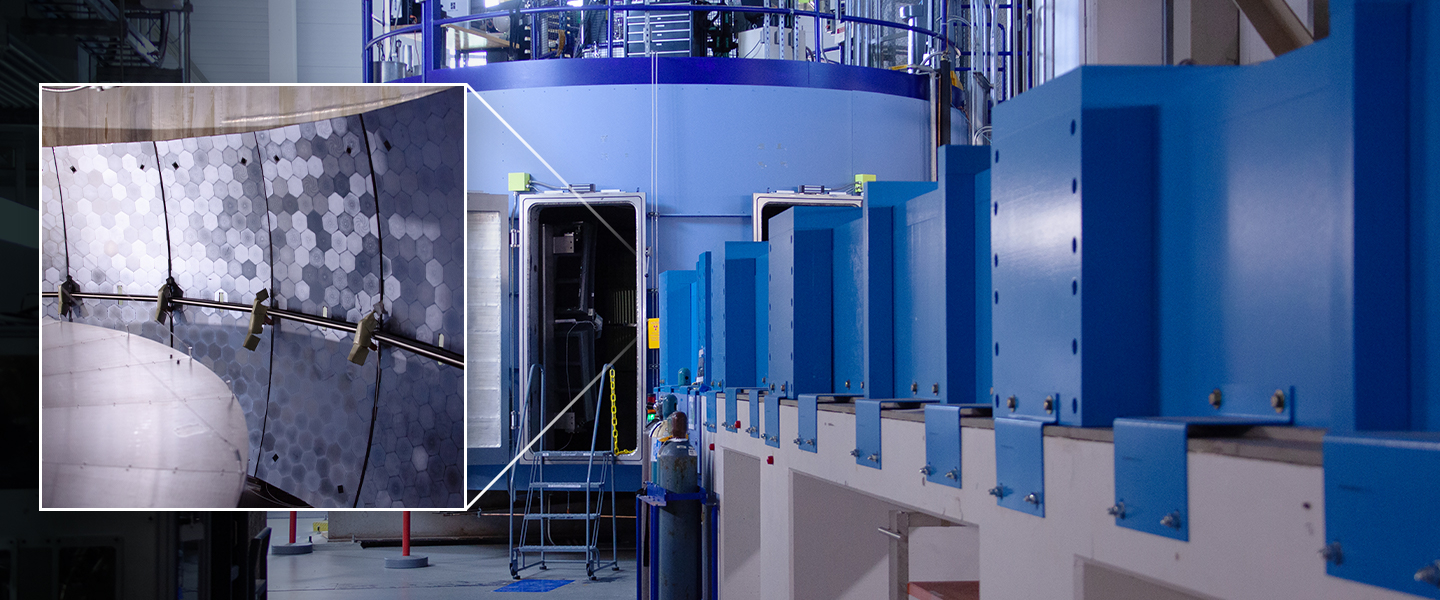
BASIS is a near-backscattering, crystal-analyzer spectrometer that provides very fine energy resolution, as low as 3.0 to 3.5µeV at the elastic peak (depending on sample size). This requires a long initial guide section of 84 m from moderator to sample in order to achieve the timing resolution necessary for obtaining the desired energy resolution. BASIS provides an excellent dynamic range near the elastic peak of about plus and minus 100 µeV in the standard high-intensity operation regime, which, if needed, could be extended to plus and minus 200 µeV and beyond. The spectrometer is optimized for quasielastic scattering but provides about 0.1% resolution in energy transfers up to ~40 meV; the inelastic excitations need to be very sharp in order to be measurable at high energy transfers.
For detailed information about BASIS, please refer to "A time-of-flight backscattering spectrometer at the Spallation Neutron Source, BASIS" Mamontov, E., and Herwig, K. W., Review of Scientific Instruments 82, 85109 (2011).
 

Applications

BASIS can be used to probe dynamic processes in various systems on the pico- to nanosecond time scale. It is well suited for probing diffusive and relaxation motions. Applicable fields of study include, but are not limited to:
  • Water and aqueous materials
  • Biosystems and biomaterials
  • Polymers and polymer-nanocomposites
  • Bulk and confined ionic liquids
  • Organic molecules (bulk and confined)
  • Metal hydrides and confined hydrogen
  • Solid state ionic conductors
  • Hybrid perovskites
  • Magnetic and quantum materials


Specifications

With Si(111) analyzers

Elastic energy

2.08 meV

Bandwidth ±100 μeV or ±200 μeV
Resolution (elastic) 3.5 μeV
Q range (elastic) 0.2 Å-1 < Q < 2.0 Å-1
Solid angle 1.8 sr


With Si(311) analyzers


Elastic energy

7.63 meV

Bandwidth

±660 μeV or ±1700 μeV

Resolution (elastic)

15 μeV

Q range (elastic) 0.4 Å-1 < Q < 3.8 Å-1
Solid angle

0.6 sr