

Contacts
-

Instrument Scientist
-

Instrument Scientist
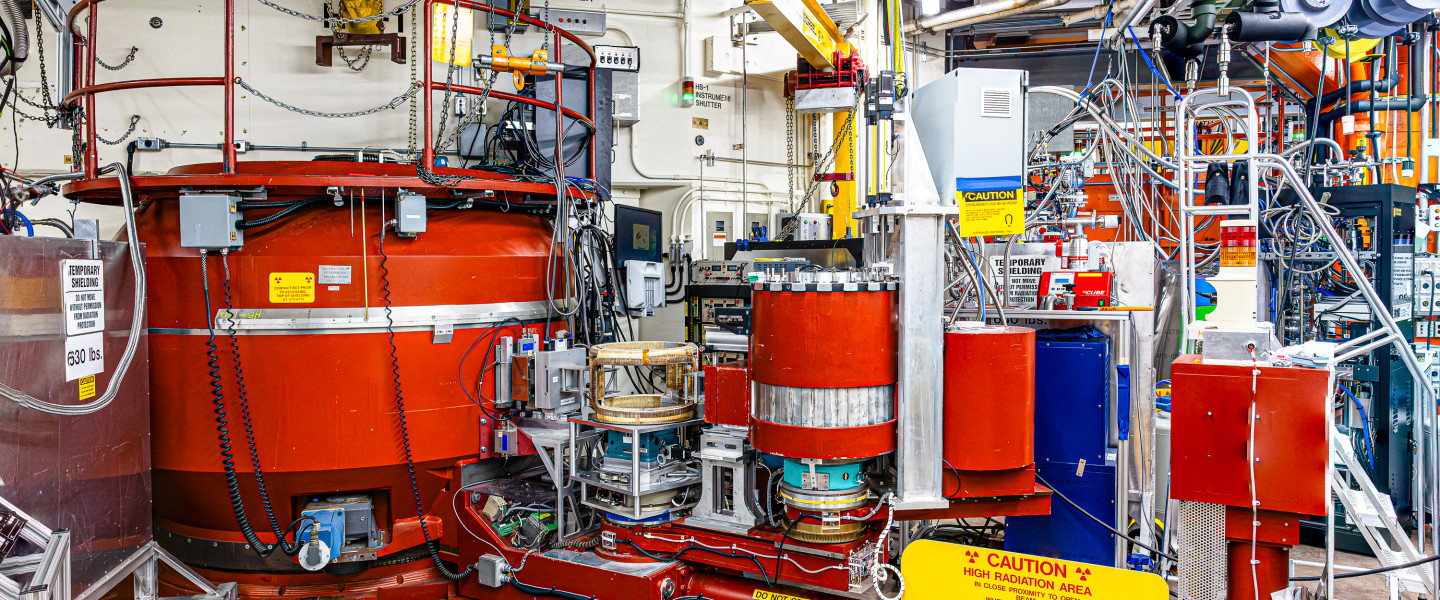
HB-1 is a versatile spectrometer to study static and dynamic properties of spin and lattice using polarized neutrons..
Of the four triple-axis spectrometers installed at HFIR, HB-1, which accommodates the vertical focusing Heusler monochromator, is specifically designed for polarized diffraction and inelastic scattering measurements. The instrument offers a choice of Heusler analyzer (for full-polarized experiments) and PG analyzer (for half-polarized experiments). The polarized setup is designed to be compact enough to accommodate all available sample environment equipment, including a 4He/3He dilution refrigerator, standard 4He flow cryostats, a cryofurnace, and a variety of closed-cycle refrigerators. Using the Wollaston Prisms setup, ultra-high energy and Q resolution measurements have become possible (https://fankangli.ornl.gov/). The spherical neutron polarimetry (SNP) enables the measurement of full polarization change in the scattering process, providing a unique way to study complex magnetic structures (Contact: jiangc@ornl.gov).
Note: HB-1 is dedicated to polarized neutron experiments with thermal neutron beam. For unpolarized thermal neutron studies, the use of HB-3 or VERITAS is recommended.
HB-1 is suited for parametric studies of spin and lattice excitations in specific areas of energy and momentum space in materials, such as multiferroic materials, thermoelectric materials, high-temperature superconductors, geometrically frustrated magnets, and quantum magnets, using high flux polarized neutrons. It can accommodate a wide variety of sample environments including high temperature furnaces (< 1770 K), ultra-low temperature cryostats (> 0.03K), vertical field cryomagnets (< 8T), pressure cells (< 2GPa), and bipolar electric field sticks (< 10kV). The half polarization technique is used to map out spin density distributions in magnetic compounds and observe chirality in frustrated magnets. The longitudinal polarization analysis is used to determine detailed spin direction and also separate magnetic and nuclear components in magnetic materials. The materials best suited for study on HB-1 facilitate power and data transmission in computers, cell phones, and power lines; impact the capacity of computer memory (hard disk); improve the efficiency of electric devices and power plants; and are vital to the eventual development of a quantum computer.
| Beam Spectrum | Thermal |
| Monochromators | Polarized Heusler(111) (vertically focused) |
| Analzyers |
Polarized Heusler(111) (horizontally focused)
Unpolarized PG(002) (vertically focused)
|
| Monochromator angle | 2ΘM = 14 – 45° |
| Sample angle | +/- 180° |
| Scattering angle | –10 – 110° |
| Analyzer angle | –10 – 90° |
| Collimations (FWHM) | Premonochromator: open (48') Monochromator-sample: 20', 40', 60', 80' Sample-analyzer: 60' Analyzer-detector: 20', 70', 90', 120', 210', 240' |
Instrument Scientist
Instrument Scientist






Oak Ridge National Laboratory is managed by UT-Battelle LLC for the US Department of Energy
