

Contacts
-

Instrument Scientist
-

Instrument Scientist
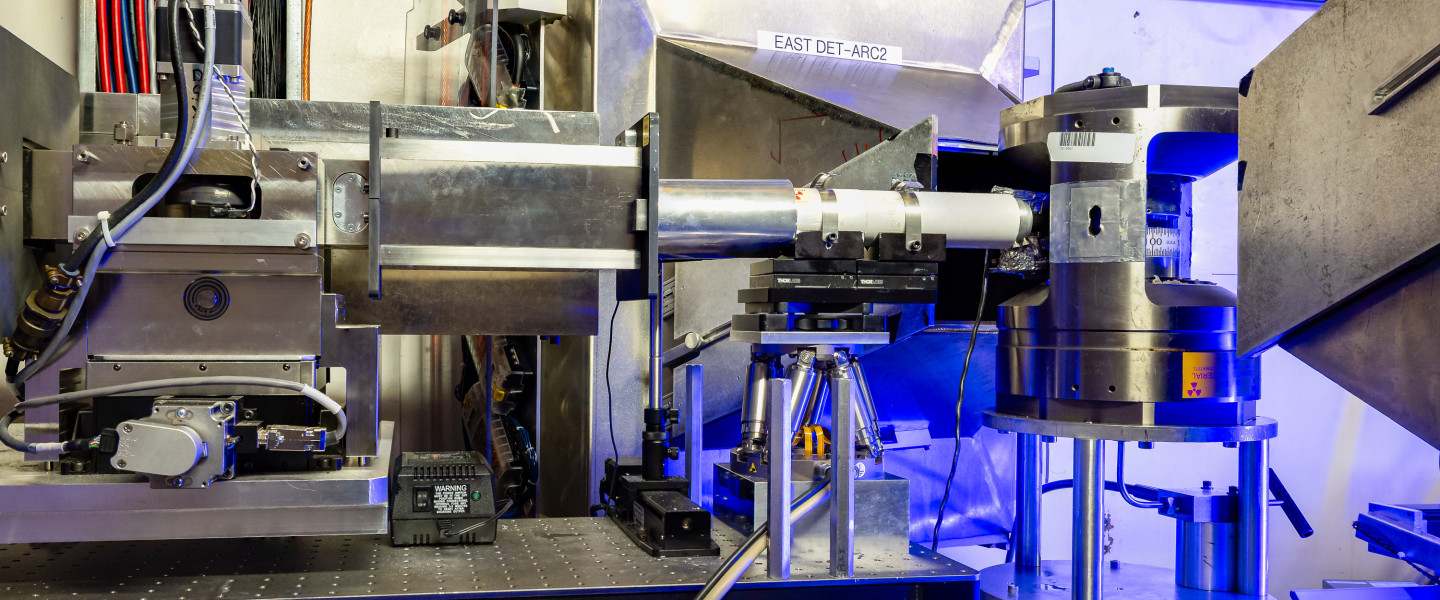
A micro-diffraction beamline for extreme-conditions research, spanning high-pressure science and other challenging samples available only in small quantities.
SNAP is a high-flux neutron diffractometer with tuneable resolution for studying materials under extremes. It combines large-area spatially resolved detectors, beam-focusing optics, and a versatile suite of pressure devices to enable diffraction measurements on very small samples from within complex sample-environments. Core sample-environment capabilities include the Paris–Edinburgh press, SNAP’s unique large-volume diamond anvil cells (DACs), and the SNS’s broader gas-pressure and clamp-cell infrastructure. SNAP is used to investigate both average and local structure in crystalline and amorphous materials and is suitable for powder, single-crystal, and liquid samples. Designed as a true micro-diffraction instrument, SNAP can measure extremely small crystalline samples, including powders of less than 0.2 mg. This capability is especially valuable for studies of samples recovered from a wide range of extreme environments (recovered from high pressure, high radiation environments, etc), highly absorbing materials that are traditionally difficult to measure with larger sample volumes, and other specimens that cannot be produced in large quantities.
SNAP is dedicated to studying the effects of extreme environments, in- and ex-situ, from a wide range of sceince areas:
| Moderator | Decoupled poisoned supercritical hydrogen |
| Source to sample distance | 15 m |
| Sample to detector distance | 0.5 m |
| Angular coverage |
Two detector banks, in-plane and out-of-plane coverage +/- 22.5° Each bank is independently repositionable at a central 2Θ of 50, 65, 75, 90, 105, 115o |
| Wavelength Range (bandwidth) | |
| Frame 1 | 0.5 – 3.65 Å |
| Frame 2 | 3.7 – 6.5 Å |
| Pressure range | Paris-Edinburgh Press: 20 GPa, DAC: 40 GPa |
| Beam dimensions | Variable, 0.25 to 100 mm2 |
Instrument Scientist
Instrument Scientist






Oak Ridge National Laboratory is managed by UT-Battelle LLC for the US Department of Energy
