

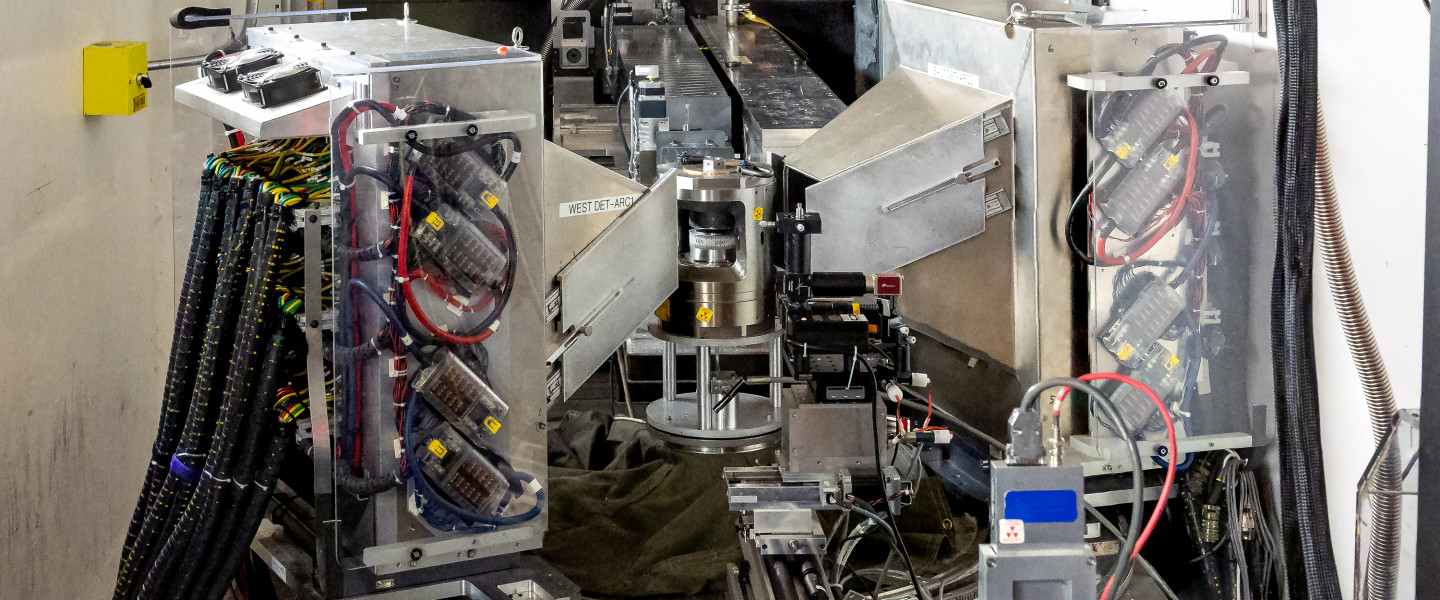
Powder crystallography: tunable resolution, dependent on required d-spacing range. Each detector can be positioned independently, and refined jointly to combine the benefits of d-spacing range and resolution. Multiple chopper settings can be used to extend the d-spacing range up to 15 Å with limited resolution and low flux (suitable for a strong signature). The instrument is compatible with a 50 mm orange cryostat (1.8 K), and a 70 mm closed-cycle refrigerator (10 K).
Single-crystal diffraction. SNAP can measure very small single-crystal samples, detecting remarkably weak signatures. However, with a limited detector coverage, you must have a well aligned, and well thought-through experiment. In the Paris-Edinburgh press, or the DAC, we are limited in access to reciprocal space, and so the science must be well targeted, and the crystals must be well aligned in advance.
Disordered materials studies (glasses/liquids/sloppy crystals at HP): low-resolution wide Q-range mode, 0.6 < Q < 20 Å-1, at temperatures between 90–300 K and pressures up to 10 GPa in the Paris-Edinburgh press. Currently this is achievable without a pressure medium.
Software: SNAP uses MANTID for all data reduction, using SNAP Reduce (SNAPRed) for all powder reduction and data exporting.






Oak Ridge National Laboratory is managed by UT-Battelle LLC for the US Department of Energy
